

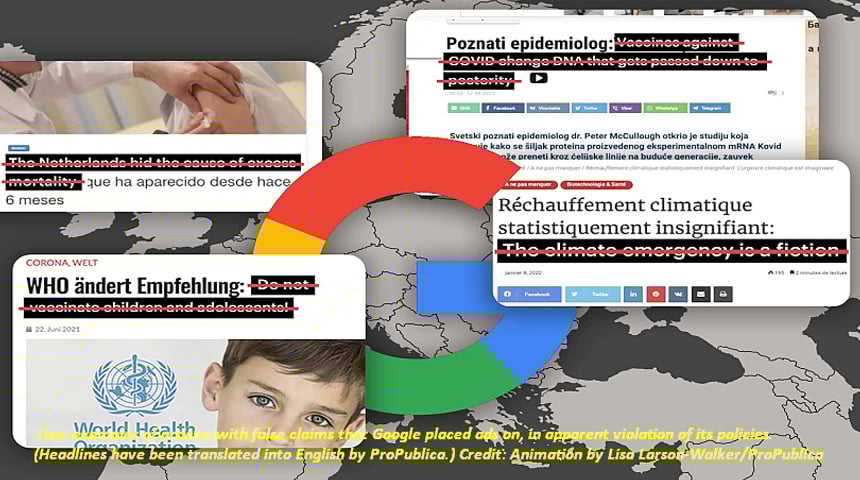
Google is funneling revenue to some of the web’s most prolific purveyors of false information in Europe, Latin America and Africa, a ProPublica investigation has found.
The company has publicly committed to fighting disinformation around the world, but a ProPublica analysis, the first ever conducted at this scale, documented how Google’s sprawling automated digital ad operation placed ads from major brands on global websites that spread false claims on such topics as vaccines, COVID-19, climate change and elections.
In one instance, Google continued to place ads on a publication in Bosnia and Herzegovina for months after the U.S. government officially imposed sanctions on the site. Google stopped doing business with the site, which the U.S. Treasury Department described as the “personal media station” of a prominent Bosnian Serb separatist politician, only after being contacted by ProPublica.
Google ads are a major source of revenue for sites that spread election disinformation in Brazil, notably false claims about the integrity of the voting system that have been advanced by the incumbent president, Jair Bolsonaro. Voters in Brazil are going to the polls on Sunday with the outcome in doubt after Bolsonaro’s unexpectedly strong showing in the first round of voting.
The investigation also revealed that Google routinely places ads on sites pushing falsehoods about COVID-19 and climate change in French-, German- and Spanish-speaking countries.
The resulting ad revenue is potentially worth millions of dollars to the people and groups running these and other unreliable sites — while also making money for Google.
Platforms such as Facebook have faced stark criticism for failures to crack down on disinformation spread by people and governments on their platforms around the world. But Google hasn’t faced the same scrutiny for how its roughly $200 billion in annual ad sales provides essential funding for non-English-language websites that misinform and harm the public.
Google’s publicly announced policies bar the placement of ads on content that makes unreliable or harmful claims on a range of issues, including health, climate, elections and democracy. Yet the investigation found Google regularly places ads, including those from major brands, on articles that appear to violate its own policy.
ProPublica’s examination showed that ads from Google are more likely to appear on misleading articles and websites that are in languages other than English, and that Google profits from advertising that appears next to false stories on subjects not explicitly addressed in its policy, including crime, politics, and such conspiracy theories as chemtrails.
A former Google leader who worked on trust and safety issues acknowledged that the company focuses heavily on English-language enforcement and is weaker across other languages and smaller markets. They told ProPublica it’s because Google invests in oversight based on three key concerns.
“The number one is bad PR — they are very sensitive to that. The second one is trying to avoid regulatory scrutiny or potentially regulatory action that could impact their business. And number three is revenue,” said the former leader, who agreed to speak on the condition that their name not be used in order not to hurt their business and career prospects. “For all these three, English-speaking markets primarily have the biggest impact. And that’s why most of the efforts are going into those.”
ProPublica used data provided by fact-checking newsrooms, researchers and website monitoring organizations to scan more than 13,000 active article pages from thousands of websites in more than half a dozen languages to determine whether they were currently earning ad revenue with Google. (To read a detailed breakdown of how ProPublica obtained and analyzed the data, see this accompanying article.)
The analysis found that Google placed ads on 41% of roughly 800 active online articles rated by members of the Poynter Institute’s International Fact-Checking Network as publishing false claims about COVID-19. The company also served ads on 20% of articles about climate change that Science Feedback, an IFCN-accredited fact-checking organization, has rated false.
A number of Google ads viewed by ProPublica appeared on articles published months or years ago, suggesting that the company’s failure to block ads on content that appears to violate its rules is a long-standing and ongoing problem.
In one example, Google recently placed ads for clothing brand St. John on a two-year-old Serbian article falsely claiming that cat owners don’t catch COVID-19. Google placed an ad for the American Red Cross on a May 2021 article from a far-right German site that claimed COVID-19 is comparable in danger to the flu. An ad for luxury retailer Coach was recently attached to an April article in Serbian that repeated the false claim that the COVID-19 vaccines change people’s DNA.
Last August, the Greek edition of the Epoch Times, a far-right U.S. publication connected to the Falun Gong spiritual movement, published an article that falsely claimed the sun, and not increased levels of carbon dioxide, could be responsible for global warming. That story had multiple Google ads when ProPublica viewed it, even though it appears to clearly violate Google’s policy against climate disinformation.
A spokesperson for the Red Cross said its ad appeared on the far-right German site due to an automated placement it did not directly control.
“Please note that based upon our Fundamental Principles of impartiality and neutrality, the Red Cross does not take sides in issues of a political, racial, religious or ideological nature, so we would purposefully not advertise on a story or site such as the one you shared with us,” said a statement from the organization.
Coach and St. John did not respond to requests for comment.
Google’s policy is to remove ads from individual articles that violate its rules, and to take sitewide action if violations reach a specific undisclosed threshold. Google removed ads from at least 14 websites identified in the investigation after being contacted by ProPublica.
Google spokesperson Michael Aciman said the company has put more money into non-English-language enforcement and oversight, which has led to an increase in the number of ads blocked on pages that violate its rules. He declined to provide figures or to say how many people Google has working on non-English-language content and ad review.
“We’ve developed extensive measures to tackle misinformation on our platform, including policies that cover elections, COVID-19 and climate change, and work to enforce our policies in over 50 languages,” Aciman said. “In 2021, we removed ads from more than 1.7 billion publisher pages and 63,000 sites globally. We know that our work is not done, and we will continue to invest in our enforcement systems to better detect unreliable claims and protect users around the world.”
Google continues to review the sites and pages ProPublica shared with it and is “taking appropriate action on any content that violates our policies,” Aciman said.
The data about ad removals comes from Google’s most recent Ads Safety report, which emphasized the removal of ads from more than half a million pages that violated policies against harmful claims about COVID-19 and false claims that could undermine elections. But Google does not release a list of pages or publishers it took action against, the countries and languages they operate in or other data related to its Ads Safety report.
News Source link
